


In the WNBA, where talent runs deep and margins are slim, winning takes more than athleticism alone. Instead, it frequently comes down to execution, focus, and attention to detail—especially on the defensive end.
But it isn’t simply “good” defense that stands out; it’s the type of defensive traits that separate the good enough from the truly great. I pored through defensive metrics for the previous 10 champions, looking for the sisterhood bond linking the teams. Together, foul rate and defensive rating, amongst others, help tell the story of who has won and who could win.
A key sign of a championship-caliber team isn’t just its scoring or rebounding ability, but its discipline in playing solid, low-foul defense. This subtle yet crucial aspect of the game often separates contenders from pretenders. A pattern among championship-winning teams reveals a defensive philosophy rooted in control rather than aggression—an approach that limits opponents’ trips to the free throw line while showcasing a broader strategy built on precise positioning, sharp anticipation, and physicality that stays within the bounds of the rules. These teams don’t simply defend; they defend intelligently, turning discipline into a competitive advantage.
Before I dive in, some context. While metrics like defensive rating (DRTG) provide valuable insights into a team’s overall defensive efficiency, they do not capture the nuances of individual defensive actions that contribute to a team’s success. In other words, DRTG is not a perfect indicator of defensive success. It helps but doesn’t paint the complete picture. It’s why I’m using it alongside foul rate, and why I’m also not making any causal or definitive statements about the data found. I’m merely using the data to analyze and evaluate what is usually a universally understood ethos: defense wins championships.
Over the past decade, examining the fouls per game of WNBA champions reveals a clear trend: these teams consistently rank among the league’s best in committing the fewest fouls.
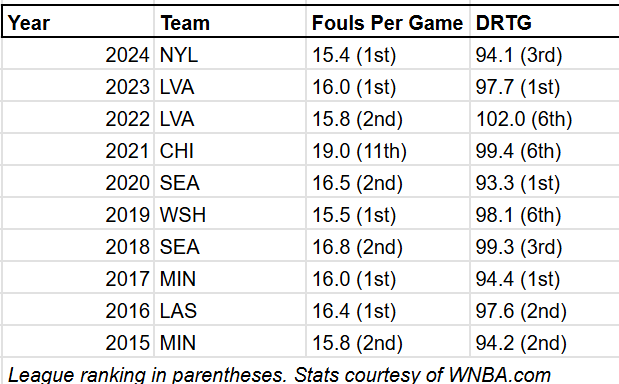
A few things stand out right away. First, the 2021 Chicago Sky remains a remarkable outlier. More importantly, championship teams consistently share a key trait: strong defense and ranking among the league’s best in committing few fouls per game.
To better illustrate this point, I created a scatter plot for visual representation.

Note that all but one champion had a DRTG under 100 points given up per 100 possessions, and each team committed fewer than 20 fouls per game. This data provides only a glimpse of the full story. Over the past 10 seasons, 100 teams—including the champions—have met this threshold. This year, six teams are on pace to reach those numbers.
While there isn’t a causal relationship between these metrics and championships, the correlation between low foul rates and championship success is not coincidental. Teams that commit fewer fouls per game often exhibit superior defensive fundamentals. They maintain proper spacing, move their feet effectively, and contest shots without unnecessary contact. Strong defense decreases opponents’ free throw opportunities, limiting easy points and controlling the game’s pace.
Sometimes this comes as a great individual effort on the defensive end. In the clip above, Breanna Stewart does an excellent job of slowing down the fast break by staying in front of the ball handler and rotating her hips to use the baseline as an extra defender. As the ball handler brings the ball around to the front of the basket, Stewart stays square, braces for the contact initiated by the ball handler, and remains vertical, thereby defending without fouling. This, among so many other fantastic defensive examples, is what helped the New York Liberty win the championship last season.
Sometimes these defensive plays are based on a few players positioning themselves smartly. In the clip above, from the 2020 Seattle Storm, note how each of the players moves their feet to stay square and prevent fouling.
Sometimes, the collective defense is so tight and cohesive that all five defenders are consistently in the right position.
This is the case with the 2022 Las Vegas Aces. In the clip above, Jackie Young and Kelsey Plum immediately communicate about switching assignments on the dribble handoff. Dearica Hamby bodies the screener to prevent the roll. Plum flashes past to stay on the ball handler. As the ball returns to the screener, Hamby meets her on the catch without fouling. On the drive, Hamby moves her feet, keeps herself square, and in front. As Plum drops to help, Chelsea Gray cuts the stunt, giving Plum time to recover. Plum stays in front of the driver, doesn’t foul, but presses on them. It would be easy for Plum to foul, but she stays patient and forces a bad shot.
Right at the end, there could be an argument for a foul on the attempt at the rim. However, when teams play such effective and routine defense, referees’ whistles seem to get swallowed. Suppose your team is constantly in the right position, abiding by the principle of verticality, moving their feet, and understanding whether to switch or stay on screens. In that case, they’re likely to persuade referees to ignore it when they initiate contact.
Do you know which teams usually play defense this well? The champions.
A team’s tenacious defense often extends beyond the half-court. The clip above is from the 2016 Los Angeles Sparks, who used full-court pressure to disrupt offensive timing. Again, very active defenders, hands splayed out, and quick feet to pressure offensive players on the catch. When the offense settles into a pick-and-roll action, the big switching onto the ball handler is seamless. As the ball eventually reaches the post, the big defender drops and chokes the post, instantly pressuring the offense and forcing a turnover without fouling.

The clip above demonstrates another full court pressure attack. The 2015 Minnesota Lynx used this routinely to turn vaunted defensive play into quick offense. In the clip, full court pressure is established to disrupt the offensive rhythm. Another critical aspect of defensive execution is knowing your personnel. A team needs to know its hard gaps, or who it can pressure on the catch versus who it should sag off of because they’re a poor shooter. That’s where high-level scouting comes into play.
The clip highlights this perfectly. The big defender plays defense where if the shot goes up from their assignment, they’re close enough to contest, but recognizing they aren’t the smoothest shooter, can slightly drop in coverage. When the offense initiates a pick-and-roll, the big slides over to cut off the lane, but can recover enough to somewhat contest the big’s jumper.
Teams that excel in minimizing fouls per game often exhibit a more sustainable defensive performance. By avoiding unnecessary fouls, these teams prevent opponents from gaining easy points through free throws, thereby maintaining defensive pressure without compromising their defensive schemes. This approach not only enhances defensive efficiency but also contributes to overall team success.
Take a look at the chart below.
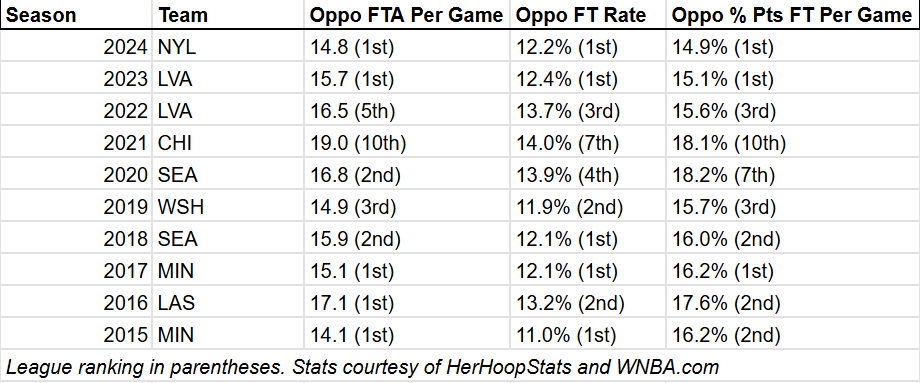
These numbers highlight a crucial aspect of team success. When a team’s defense can limit fouling, it limits the amount of free points they give an opposing team. Common sense would tell us this likely means the offensive team has to work harder to score the ball. When each of these teams can limit fouls and promote a better-than-average defensive front, they aren’t putting teams on the line. This discipline puts more pressure on offenses to execute perfectly, which inevitably hurts their overall execution.
Again, it is important to note that these observations do not establish a direct, causal relationship between low foul rates and championship success. Rather, they suggest a correlation: teams that commit fewer fouls per game often exhibit defensive discipline that contributes to overall team success. This correlation indicates that while low foul rates alone do not guarantee a championship, they are often characteristic of teams that perform well in high-pressure postseason scenarios.
As such, it’s pertinent to see which teams in 2025 are leading the league in fouls per game and defensive rating. These teams might not reach the finals or win the championship, but they still hint at potentially interesting circumstances.

Both lists include last year’s finals matchup. It also includes four other teams likely to compete for the playoffs. If these teams can keep pace in these categories while maintaining effective offensive production, one of them could hoist the trophy at season’s end.
All 2025 team stats through June 17. All stats courtesy of WNBA.com unless otherwise noted.


test test test