


After standing out in Unrivaled last winter—winning the league’s inaugural Defensive Player of the Year award—the question entering Angel Reese’s second professional season was simple: how much of her growth in the modified three-on-three format would carry over to the five-on-five reality of the WNBA? Mind you, Reese, dating back to her early college days at Maryland, has always shown a knack for evolution. On and off the court, she’s consistently resisted complacency—meaning there was every reason to believe much of what she showcased in Miami would eventually shine through in the more calculated (and often more complex) world of traditional five-on-five play.
And so far, Angel Reese has not disappointed. Even with midseason injuries repeatedly interrupting her momentum, she’s made one thing clear: the growth she displayed while leading Rose BC to the Unrivaled championship was not only real, but something she could translate to the W in short order. The result? Tangible improvement across nearly every major statistical category, including scoring (+0.8 points per game [PPG]), efficiency (+6.5 field goal percentage), and defensive involvement (+0.3 stocks [steals + blocks]per game). In fact, the only category where her numbers have dipped is on the glass, where she’s averaging 0.8 fewer rebounds per game than during her historic rookie season. Even then, her per-36-minute rebounding numbers are nearly identical year over year.
Elevating Playmaking: Assists
Yet above all those other metrics, one stands out: assists. No matter how you measure her productivity in this area, one thing is clear: Reese hasn’t just improved on her own rookie numbers; she’s among the best in the league, at her size, when it comes to sharing the rock.
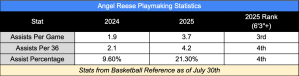
The question for Chicago, then, is how these improvements on the stat sheet translate into a more effective offense, and so far, she has offered several clear answers. As you might expect, the most immediate impact shows up in her post passing, particularly in her connection with Kamilla Cardoso. In many ways, this isn’t entirely new—Angel Reese flashed that playmaking potential as a rookie—but it remains a valuable part of her repertoire.
From these examples (a small sample of her total assists from the post), a couple of things stand out. First, Reese has a much better grasp of her gravity than she did as a rookie: many of the missed or blocked post-up attempts she forced against double teams last season now end in textbook offloads to Cardoso or Elizabeth Williams. Second, she’s capable of executing passes well beyond textbook difficulty. For a player who brings so much personality to the game, it’s no surprise her passes carry some flair—but crucially, that panache doesn’t come at the expense of efficiency. While she does occasionally post high turnover numbers, those typically stem from other areas, the style Angel Reese adds in these moments making her passes more effective and her teammates’ looks easier.
Working Overtime in the Post
While elements of that playmaking skill were visible last season, a different facet—centered on Reese’s work off the dribble—has emerged far more frequently this year. This development owes much to Unrivaled’s high-tempo style and extreme spacing (at least compared to traditional five-on-five). That said, rookie head coach Tyler Marsh—and an unfortunate, hand-forcing injury to veteran floor general Courtney Vandersloot—deserve significant credit for giving Reese more opportunities to create for others with the ball in hand, away from the basket.
Indeed, Marsh—for all the hurdles he’s faced as a rookie head coach—has effectively corrected one of the biggest oversights of the brief Teresa Weatherspoon era: allowing Reese to create advantages against opposing bigs with the ball in space. It was an obvious strength of hers in college, and while those athletic skills were never going to be quite as dominant against professionals, Weatherspoon and her staff often forced Reese into uncomfortable post matchups, limiting her chances to score off the dribble and put her creative vision to use. This season, those opportunities have been plentiful, and much of Reese’s statistical growth as a playmaker comes from this area.
These examples also highlight multiple facets of Reese’s playmaking. Some plays, like the drives that carry her into the low post, aren’t all that different from the post passes in the previous video. When she uses her explosive first step to create separation and get by her defender, she often draws a second defender on her way to the basket—setting up Cardoso as the likely beneficiary of an offload similar to the ones Reese delivers from a more traditional post-up.
However, the emerging—and exciting—side of her off-the-dribble skill set shines most in the first and last clips, where she creates opportunities by passing back out to the perimeter. These plays reveal a high level of patience and awareness. While scoring off the bounce or collapsing the defense to set up a layup are valuable skills, the ability to spray passes across the floor adds an entirely different dimension to her value as a ball-handler. In that respect, the absence of Vandersloot (and, at times, Ariel Atkins) has been especially revealing, as it’s pushed Reese to add layers to her work as a creator off the dribble.
Increase in Transition Opportunities
And while we’re analyzing her work with the ball in time and space, it’s worth considering her impact as a break starter. After all, a player who collects as many defensive rebounds as she does—and has the confidence to handle the ball without the support of a guard—should consistently get chances for decisive outlet passes, and Reese is no exception.

The main criticism in this area—perhaps evidenced by the limited number of clips—is that Angel Reese probably doesn’t look for outlet passes enough. Because she’s so capable of going coast-to-coast with the ball and often initiates the offense in the half-court, she frequently takes on one of those two roles—sometimes costing the Sky a chance at true early offense. After all, when she hauls in a defensive rebound, she’s typically the furthest player from the basket—meaning all five defenders have an opportunity (theoretically, at least) to stop her on the way to the rim. It may sound nitpicky, but it’s crucial for Chicago—currently 11th in the WNBA in fast-break scoring (8.9 PPG) and field-goal percentage (41.9 percent)—to create as many early, often easy, scoring opportunities as possible before the defense can set.
Indeed, this team needs all the offensive help it can get—and in truth, it’s hard to offer much criticism of Reese, whose impact before injury was thoroughly felt across the board. Between her field goals (123) and assists (89), Reese—who had been leading the team in both categories—is directly responsible for 30.2 percent of all made shots by Chicago in games she’s played this season. Consider also the team’s offensive rating with her on the floor (98.1) compared to when she sits (90.5), or the meager 65.1 points per game (PPG) they averaged in the ten contests she’s missed so far (compared to 79.5 PPG in the 24 she’s played), and it becomes clear: Reese is far more solution than problem for this offense.

And truthfully, while the Sky’s offensive struggles are real, their long-term significance is harder to gauge given the changes coming to the league’s landscape next offseason. What does matter is the growth Angel Reese has shown—particularly as a playmaker—which stands as a clear positive for the franchise moving forward. Marsh echoed that sentiment after Reese recorded the first double-digit assist game of her career in a triple-double performance against Connecticut on June 15. The two-time world champion assistant called the “ability and willingness” of Reese—and fellow frontcourt cornerstone Cardoso—their “best attribute,” praising how effectively they’ve created opportunities for others.
And given what she showcased in Unrivaled, there’s every reason to believe Reese has only scratched the surface of her ceiling as a playmaker. With more refinement of her role in the years ahead—guided by Marsh and his staff—further growth seems not just possible, but likely. Of course, Reese will also be pushing herself to evolve, and the work ethic she displayed alongside fellow stars in Miami should serve her well. One of the league’s co-founders, Alex Bazzell, told Chicago State of Mind at All-Star weekend that Reese was often the first to arrive and last to leave the state-of-the-art facilities—adding that her potential is “unlimited.”
Angel Reese used a similar word to describe her vision for her game, saying after her triple-double that she wanted to become “unstoppable”—on account of her ability to create scoring opportunities for both herself and others. There’s still plenty of work ahead, both for Reese and the franchise around her, but the strides she’s made this season already point to a more dynamic offensive threat than many expected her to become.
All stats as of August 21st. Unless otherwise noted, all stats courtesy of Basketball Reference and WNBA.com.


